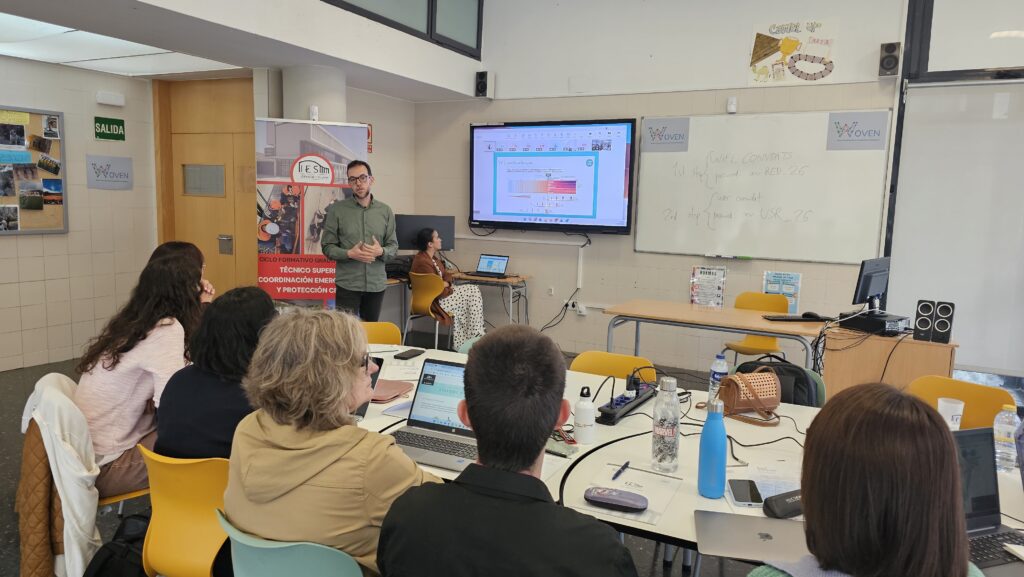


The third and final training day of the European WOVEN project brought three intensive days of shared learning between vocational education and training teachers from Spain and Portugal to a close. IES Jérica-Viver once again became a venue for the exchange of experiences, reflection and collaborative work, consolidating the knowledge gained on green skills and their application in the educational setting. The event concluded with a heartfelt farewell ceremony and a closing lunch, allowing participants to bring this international experience to a close in a convivial atmosphere.
Teachers present their teaching proposals
The day began with a presentation of the lesson plans that the participants had drawn up the previous day. This activity provided an opportunity to see how each teacher had adapted the materials and resources from the WOVEN project to the specific context of their subject and their school.
The presentations showcased a wide variety of approaches and methodologies, reflecting the richness that collaboration between professionals from different educational backgrounds brings. The proposals incorporated green skills from a wide variety of perspectives, demonstrating that sustainability can be integrated across the board into vocational education and training, regardless of the vocational sector or the students’ profile.
After each presentation, participants exchanged views, asked questions and shared suggestions to enhance the planned activities. This feedback process helped to improve the proposals and reinforced the collaborative spirit that has characterised the entire training programme.
As well as serving as a practical exercise, this activity made it possible to assess the teachers’ progress over the course of the sessions, demonstrating how the material covered had been internalised and transformed into resources that could be applied in the classroom.
A debate to explore environmental communication in greater depth
Following the presentations, Josep Antoni Nebot, a journalist specialising in environmental issues, resumed his participation in the conference with a session focused on dialogue and the exchange of ideas.
Far from being confined to a traditional presentation, the event took the form of an open discussion in which teachers were able to explore many of the topics covered during the previous day’s session in greater depth. Participants shared their thoughts on the role of communication in raising environmental awareness, the importance of combating misinformation, and strategies for bringing climate challenges closer to the public in a rigorous yet accessible way.
The exchange of views helped to broaden the horizons of all those present and highlighted the importance of fostering critical thinking both in education and in society at large.
During his speech, Josep Antoni Nebot also presented various examples of business initiatives driven by entrepreneurs committed to sustainability. These projects demonstrated that it is possible to develop innovative business models that combine respect for the environment with the creation of economic and social value for the region.
The presentation of these experiences served as a source of inspiration for the teaching staff, showcasing real-life cases that can be used as examples in the classroom to introduce pupils to new forms of sustainable entrepreneurship.
Climate change and sustainability: an expert’s perspective
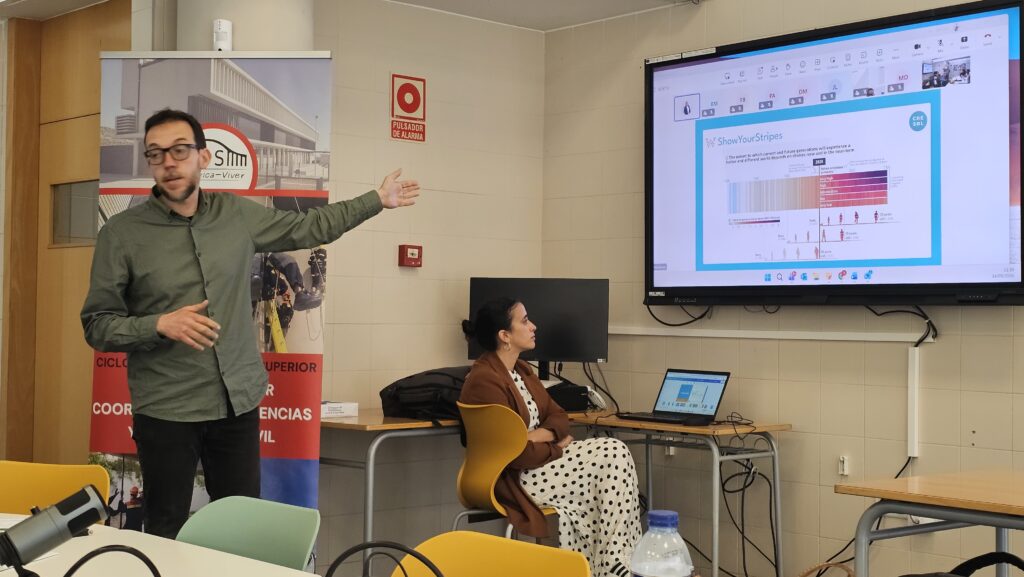
The training session continued with a talk by José Segarra, an expert from CRESOL, who gave a presentation focusing on one of the major challenges of our time: climate change.
Throughout his presentation, he explored the causes and consequences of this phenomenon, as well as the need to adopt measures that would facilitate a transition towards more sustainable models of development. He also highlighted the vital role that education plays in preparing future generations for the environmental challenges that will shape the future.
His presentation helped to link the topics covered during the conference to current social, economic and environmental realities, emphasising the importance of vocational education and training incorporating this knowledge across the board into its educational programmes.
The session sparked great interest among those present, who participated actively by asking questions and sharing their thoughts on how to apply this content to their respective specialisms.
An activity to consolidate learning
To round off the training session, the representatives from MENTORTEC organised a group activity designed to review the key concepts covered during the three days of training.
The session provided an opportunity to review the content relating to the European framework for green skills, the methodologies presented and the various tools developed as part of the WOVEN project.
Through a participatory format, the teachers were able to assess the knowledge they had acquired, clarify any remaining doubts and share the most relevant conclusions drawn from the experience.
This final exercise highlighted the eminently practical nature of the training, which was based on the active participation of teaching staff and the constant exchange of experiences between the various participating schools.
A souvenir from Alto Palancia for the participants
Before saying goodbye, IES Jérica-Viver wished to thank all those present for their involvement and commitment with a small gift symbolic of the local area.
The hosts presented each participant with a gift made in the Alto Palancia region: some artisanal jams produced in the village of Altura. This gesture not only provided a memento of the visit but also served to highlight once again the importance of supporting local produce and the local economy – a philosophy fully in line with the principles of sustainability promoted by the WOVEN project.
The gesture was received with great enthusiasm by the participants and symbolised the atmosphere of warmth and hospitality that has characterised the event from the very first day.
A meal to round off three days of shared learning
The training course concluded with a lunch held in Viver, where teachers, organisers and contributors were able to share their final thoughts before returning to their respective countries and educational institutions.
This final session served to strengthen the bonds forged during the training and to share the experiences gained over the three days. Many participants highlighted the value of collaborative learning, the quality of the materials developed and the opportunity to exchange best practice with teachers from other educational contexts.
A project that leaves its mark
This third day marked the end of the teachers’ visit to IES Jérica-Viver as part of the European WOVEN project. Over the course of three days, the participants combined specialist training, practical activities, discussions, cultural visits and experiences linked to sustainability, thereby strengthening an international network of collaboration between vocational training centres.
Beyond the knowledge gained, the event has served to reinforce the teaching staff’s commitment to an education system capable of responding to the environmental challenges of the present and the future. The resources, methodologies and experiences shared during this event will now enable green skills to be brought into the classroom, helping to train professionals who are more aware, responsible and better equipped to drive a more sustainable society.
Virtual meetings
Virtual meetings keep collaboration between project partners alive, facilitating the exchange of ideas, monitoring progress and joint decision-making, without distance being an obstacle.
Because cooperation knows no borders, and every meeting strengthens a European network that is moving forward together towards a more sustainable and inclusive education.
Training
Training is the driving force behind change. Through shared resources, methodologies and experiences, teachers acquire new tools to integrate sustainability and green skills into their teaching practice, contributing to a more innovative vocational education system that is better equipped to meet the challenges of the future.
Because learning together is the first step towards transforming classrooms and making a positive impact on society.